

For most Minnesota homeowners, composite decking is the better long-term investment: it costs more upfront but saves thousands in maintenance over a 25-year lifespan. Natural wood, particularly cedar or pressure-treated pine, still makes sense for tighter budgets or homeowners who genuinely enjoy the ritual of annual deck care. At NorBrook Construction, we build both types regularly across the western metro, and we give every client the same honest breakdown so they can choose based on their actual priorities rather than marketing hype. Our crews have installed decks through every kind of Minnesota season, and the performance differences between these two materials become obvious fast. Here's what we tell homeowners who are weighing their options.
The Minnesota Climate Challenge: Decking Performance in Extreme Seasons
Minnesota doesn't just test decking materials: it punishes them. We see temperature swings of 130 degrees or more between January lows and July highs, and that kind of range accelerates wear on any outdoor surface. The real question isn't which material looks better on installation day. It's which one still looks good after five winters and five summers of relentless thermal cycling, UV exposure, and moisture intrusion.
How Humidity and Snow Load Impact Wood Stability
Wood is hygroscopic, meaning it absorbs and releases moisture with changes in humidity. In Minnesota, where summer humidity can hover around 70-80% and winter air drops to near-desert dryness, wood deck boards are constantly expanding and contracting. That movement causes cupping, warping, and splitting: problems we see on nearly every untreated wood deck older than three years.
Snow load is another factor. A heavy wet snowfall can deposit 20+ pounds per square foot on a deck surface, and when that snow melts and refreezes in the board joints, it pries fasteners loose and opens cracks. Minnesota
deck safety regulations require specific structural standards to handle these loads, but the surface material still takes a beating. Pressure-treated pine holds up structurally, but the cosmetic damage accumulates quickly without consistent sealing.
Composite Resilience Against Freeze-Thaw Cycles
Modern capped composite boards handle freeze-thaw cycles far better than wood because their polymer shell prevents moisture from penetrating the core. We've pulled up 12-year-old composite boards during renovation projects and found them structurally identical to new stock. The cap technology that brands like Trex and TimberTech use creates a moisture barrier that wood simply can't match without annual chemical treatment.
That said, composite isn't invincible. Cheaper uncapped composites from the early 2010s did absorb moisture and developed mold problems. The catch is that you need to specify capped composite, which is now the industry standard for quality brands. Trex recently expanded its Midwest distribution through Weekes Forest Products, making their full product line more accessible to Minnesota builders like us.
Comparing Maintenance Requirements for Twin Cities Homeowners
Maintenance is where the composite vs. wood debate gets real for Minnesota homeowners. The upfront price tag tells one story; the annual time and money commitment tells a very different one.
The Annual Staining and Sanding Cycle of Natural Wood
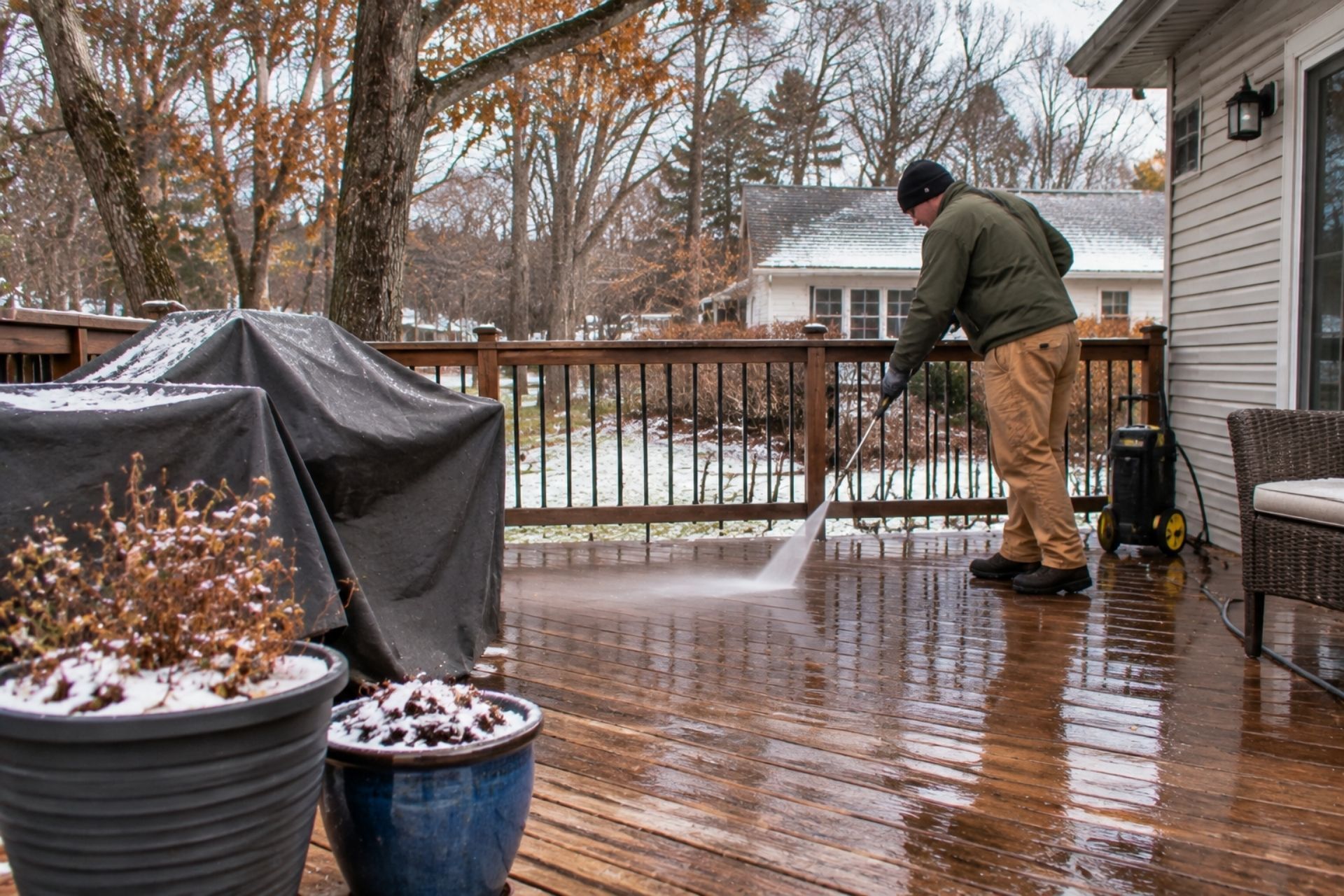
If you choose a natural wood deck, plan on spending a full weekend every spring preparing it for the season. Our recommendation for cedar or pressure-treated decks in Minnesota is a complete maintenance cycle: power wash in May, let it dry for 48-72 hours, sand any raised grain or splinters, and apply a quality penetrating stain. That stain runs $30-$50 per gallon, and most decks need 3-5 gallons per coat.
Skip a year, and you'll notice graying, surface checks, and early rot around fastener points. Skip two years, and you're looking at board replacement. We tell our clients that a wood deck in Minnesota requires roughly $200-$400 in materials and 8-12 hours of labor annually to stay in good shape. Over 20 years, that's $4,000-$8,000 in maintenance costs alone, not counting your time.
Low-Maintenance Living with Modern Capped Composites
Composite maintenance is genuinely minimal. Our crews recommend a twice-yearly soap-and-water wash and occasional spot cleaning for food or leaf stains. That's it. No sanding, no staining, no sealing. The total annual cost is essentially zero beyond the soap and a garden hose.
The 25-year warranties that major manufacturers offer reflect real confidence in the product. We've seen composite decks in Maple Plain and Plymouth that look nearly new after a decade of Minnesota weather. The color does mellow slightly over the first few months as UV exposure stabilizes the pigments, but after that initial settling period, the appearance stays remarkably consistent.
Cost Analysis: Upfront Investment vs. Long-Term Value
Here's where we get into real numbers. Framing lumber prices stabilized in late 2024 and 2025 at $500-$600 per thousand board feet, which has kept pressure-treated deck framing costs predictable heading into 2026. The decking surface material is where costs diverge significantly.
For a typical 300-square-foot deck in the Twin Cities metro, pressure-treated pine decking runs $8-$12 per square foot installed, while cedar costs $12-$18. Composite decking ranges from $15-$28 per square foot installed, depending on the product tier. That means a wood deck might cost $6,000-$9,000 total, while a comparable composite deck runs $9,000-$14,000.
The math shifts when you factor in maintenance. Over 20 years, that wood deck accumulates $4,000-$8,000 in upkeep costs plus one likely re-staining of the entire surface. The composite deck needs virtually nothing. By year 12-15, the total cost of ownership is roughly equal, and every year after that, composite is saving you money. Our project managers walk through this exact calculation with every client during the estimate process, because the right answer depends on how long you plan to stay in the home.
Minnesota also requires permits for most deck projects, and the permitting cost is the same regardless of material choice: typically $100-$300 depending on your municipality. We handle all permit applications as part of our standard process.
Direct Comparison: Material Tiers and NorBrook Recommendations
| Feature | Pressure-Treated Pine | Cedar | Entry Composite | Premium Composite |
|---|---|---|---|---|
| Cost per sq ft (installed) | $8-$12 | $12-$18 | $15-$20 | $22-$28 |
| Lifespan in MN | 10-15 years | 15-20 years | 25+ years | 25-30+ years |
| Annual Maintenance | Stain + seal yearly | Stain + seal yearly | Soap and water | Soap and water |
| Warranty | None typical | None typical | 25 years | 25-30 years (fade/stain) |
| Moisture Resistance | Low without treatment | Moderate (natural oils) | High | Very high |
| Color Options | Limited (stain-dependent) | Natural tones only | 8-12 colors | 15-20+ colors/textures |
| NorBrook Recommendation | Budget builds, short-term ownership | Homeowners who enjoy maintenance | Best overall value | Premium outdoor living spaces |
We recommend premium capped composite for most Minnesota homeowners who plan to stay in their home five years or more. The break-even point on cost makes it a clear winner for long-term ownership. For clients on a strict budget or building a cabin deck they'll enjoy maintaining, pressure-treated pine remains a solid choice. Cedar occupies an awkward middle ground: it costs nearly as much as entry-level composite but still demands annual maintenance.
Why Maple Plain Homeowners Trust NorBrook for Deck Construction
We're based in Maple Plain, and most of our deck projects are within a 30-mile radius. That local focus matters because we know exactly how the soil, drainage patterns, and municipal code requirements vary from Plymouth to Minnetonka to Orono. Our founders, the Norling brothers and Charlie Brookins, built this company around the idea that construction should feel like a partnership, not a transaction.
Elite Safety and Licensing: BC80875, Lead-Safe, and OSHA 30
We hold Minnesota residential building contractor license BC80875, which you can verify directly through the Minnesota Department of Labor and Industry. For homes built before 1978, we carry EPA lead-safe certification LFC-281, a requirement for any renovation work that might disturb lead-based paint. Co-founder Seth Norling holds OSHA 30 certification, which means our job sites follow federal safety standards from day one.
These credentials aren't just paperwork. They reflect how we train our crews and manage risk on every project. A deck build involves excavation, concrete footings, structural framing, and electrical work for lighting: each phase carries real safety considerations that we take seriously.
The NorBrook Difference: Dedicated Project Management
Every NorBrook deck project gets a dedicated project manager who provides daily or weekly updates depending on the project phase. You won't chase down subcontractors for answers or wonder what's happening on your property. Your project manager handles scheduling, material deliveries, inspections, and communication so you can focus on picking out patio furniture.
We also handle the full permitting process. Minnesota deck permits require structural plans and inspections, and our team manages all of that from application through final sign-off. That's part of our standard service, not an add-on.
Frequently Asked Questions About Minnesota Decking
Can I install composite decking over my existing wood frame? In many cases, yes. If the existing joists and ledger board are structurally sound, we can remove the old wood surface and install composite boards on the same frame. We inspect every component before making that call, because a failing ledger connection is a serious safety hazard.
How long does a deck build take in Minnesota? Most residential decks take 5-10 business days from the start of construction. Permitting adds 1-3 weeks before we break ground, depending on your city. We schedule builds from April through November, though we prefer to pour footings before the ground freezes in late October.
Does composite decking get too hot to walk on barefoot? Darker composite colors can get uncomfortably warm in direct July sun. We recommend lighter color options for decks with full southern exposure, or we can incorporate shade structures into the design. Wood stays cooler underfoot, which is one genuine advantage it holds over composite.
Do I need a permit for a deck in Minnesota? Almost always. Any attached deck or elevated structure requires a building permit in Minnesota. Even freestanding ground-level decks may need permits depending on your municipality. We pull permits on every project as standard practice.
Will a composite deck increase my home's resale value? Deck additions typically recoup 60-75% of their cost at resale in the Twin Cities market. Composite decks tend to appraise slightly higher than wood because buyers recognize the low-maintenance benefit. A well-built deck also expands your usable living space, which matters in a market where outdoor entertaining season is precious.
What composite brand do you recommend? We work primarily with Trex and TimberTech, both of which have strong distribution networks in the Midwest. The specific product line depends on your budget and aesthetic preferences, and we'll bring samples to your consultation so you can see and feel the options in person.
Your Next Step with NorBrook
Your deck should match how you actually live, not just what fits a budget spreadsheet. Whether you're leaning toward the warmth of natural wood or the longevity of composite, we'll sit down with you, walk your property, and give you a detailed estimate based on your specific site conditions and goals. Our dedicated project managers stay with your build from first conversation through final inspection, so you always know exactly where things stand.
If you're ready to talk about your deck project, call us at 763-237-5114 or Request a Free Estimate online. We'll bring material samples, walk through the cost comparison for your specific square footage, and help you make a decision you'll feel good about for the next 20 years.